

The short answer: identify the problem before choosing the format
Choose private feedback when you need another person to see what you cannot see, narrow the problem to one useful cue, and check whether you can repeat the change. Choose more practice when you already understand the correction and can reproduce it in calm, controlled efforts but have not yet made it consistent.
Neither route is automatically superior. If breathing, floating, body position, or water confidence is still missing, the honest next step may be adult foundations rather than stroke correction. If a movement causes pain or raises a health concern, stop treating it as a coaching puzzle and seek qualified medical advice. This guide is a decision framework, not an assessment or result promise.
Describe the problem in one observable sentence
"My front-crawl breathing feels wrong" is too broad to plan around. A more useful description is: "I lift my head to breathe and my legs sink," "I lose the breaststroke sequence when I try to glide," or "I can hold the correction for one easy effort but lose it when I repeat." The sentence does not have to be technically perfect. It has to describe what happens.
Also separate the goal from the symptom. A swimmer who wants a calmer recreational stroke needs a different conversation from someone asking for race pace, open-water preparation, or event coaching. Penguin should only recommend from services it can currently confirm, not assume that every performance goal fits a published adult lesson route.
Private feedback may fit when the useful cue is still unclear
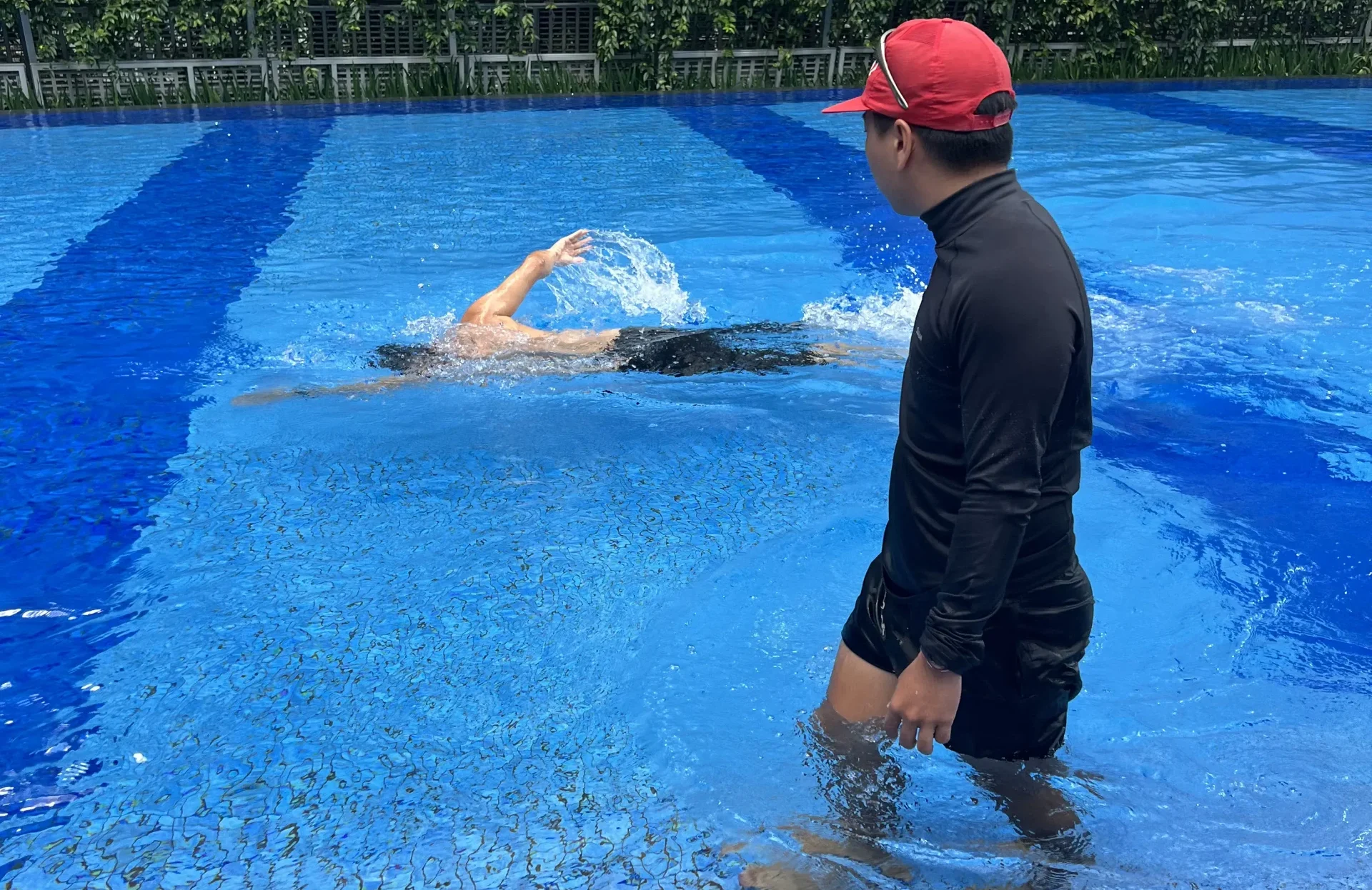
One-to-one coaching can be worth comparing when several things go wrong at once, a correction that sounds simple does not make sense in the water, or the swimmer cannot tell whether body position, breathing timing, arm path, kick, or coordination is the main blocker. Close observation can give the lesson one priority instead of a long list of simultaneous changes.
That is a format advantage, not evidence that private coaching will be faster or more effective for every adult. A coach still needs to observe the swimmer, choose a cue that the learner understands, and review whether it changes the movement. The lesson should not be sold as a guaranteed shortcut, injury-prevention method, or fixed-session correction.
More practice may fit when the correction is already understood
Practice may be the better next step when the swimmer can explain the chosen cue, demonstrate it in an easy effort, and notice when it starts to disappear. The practice task should stay narrow: one breathing rhythm, one body-position cue, or one part of the breaststroke sequence, with enough rest to keep the movement deliberate.
Do not turn practice volume into proof of progress. If the same problem remains unclear, confidence falls, or technique changes only when a coach is beside the pool, book a review instead of repeating more laps without a decision point. Practice should answer whether the correction is becoming repeatable, not prove a promised pace, distance, or outcome.
Return to foundations when the stroke is not the first problem
An adult may describe the goal as stroke correction while still holding the breath, struggling to float, rushing to stand, losing body position, or becoming anxious when the face enters the water. In that case, adding a more detailed arm cue can create noise. A calmer adult foundations plan may be the more useful route.
Confidence is not a character test, and a missing foundation is not failure. Tell the school what happens before the stroke breaks down: fear of depth, discomfort exhaling, difficulty recovering to standing, embarrassment in a shared class, or uncertainty at a busy pool. That context helps separate adult beginner support from technique refinement.
Use official technique guidance as vocabulary, not a remote assessment
ActiveSG describes front crawl through body position, alternating arm movement, breathing timing, leg action, and coordination. Its breathing guide also explains that head timing and alignment affect the stroke, while its breaststroke guide separates body position, arm movement, breathing, leg action, glide, and coordination. Those are useful categories for describing a problem.
They do not prove that a specific adult needs private coaching, how quickly a correction will hold, or whether a swimmer is ready for a distance, event, or open-water goal. Online guidance cannot see the learner, pool, fatigue, confidence, or health context. Use it to ask a clearer question, then rely on current service confirmation and in-person judgement.
Separate technique consistency from practice and fitness limits
A stroke may look controlled in an easy effort and change when the swimmer tries to go farther, faster, or with less rest. That does not automatically prove that the cue is wrong or that more private lessons are required. The limiter may involve pacing, practice consistency, general fitness, confidence, or a technique gap that appears under effort.
Set a review point before adding volume. Ask whether the same technical change remains visible in a few controlled repetitions and whether the swimmer can explain when it disappears. A coach can help observe that pattern, but should not turn it into a medical diagnosis, an injury-prevention claim, or a guaranteed performance forecast.
Pain changes the decision
A swim coach can adjust a drill or stop a lesson, but should not diagnose shoulder, neck, back, breathing, cardiovascular, or other health concerns. HealthHub exercise guidance advises stopping when pain occurs and consulting a doctor before starting an exercise regime. A learner with pain or a medical concern should obtain appropriate advice before asking coaching to solve it.
Do not use this article, an online technique page, or a lesson enquiry as medical clearance. Penguin does not provide a medical assessment through a stroke-correction conversation, and private coaching does not guarantee injury prevention. Share relevant professional guidance with the school only as needed to keep the lesson recommendation within clear boundaries.
Pool and coach fit still matter in Singapore
For a condo or private pool, confirm that outside coaching is allowed, visitor access is workable, and there is enough suitable space for observation and controlled practice. Share the pool depth, busy periods, access instructions, and management rules before expecting a coach or arrangement to be confirmed.
Coach fit includes communication, patience, cue style, adult teaching experience, privacy needs, and whether the coach can work with the swimmer's actual foundation and goal. No article can promise a named coach, pool, slot, frequency, or start date. Availability remains subject to learner fit, pool access and rules, schedule, capacity, and coach availability.
What Penguin can and cannot promise
Penguin publishes adult, private, condo, and coach-matching routes that can support a fit conversation. The useful outcome of the enquiry is a current recommendation: whether the learner appears to need adult foundations, focused private feedback, practice with a review point, a suitable condo setup, or another confirmed route.
This guide does not advertise a named stroke-correction package, underwater filming, video analysis, data analysis, triathlon coaching, open-water coaching, event coaching, medical assessment, or a fixed improvement timeline. Do not assume those services are included. Penguin must confirm the actual coach, format, pool, scope, timing, price, and availability before any arrangement.
What to send before asking for a recommendation
Send your current stroke, comfortable continuous distance, what changes when the stroke breaks down, one correction you have already tried, breathing or confidence concerns, any pain or professional restrictions, preferred pool or area, pool-access rules, available days and times, privacy needs, and one realistic goal.
That information lets Penguin distinguish a technique-feedback request from beginner foundations, general practice, fitness, or a medical boundary. It does not guarantee that Penguin will offer a particular package, coach, pool, slot, session count, performance result, or service. The recommendation remains subject to current service truth and fit.