


SwimSafer Certification
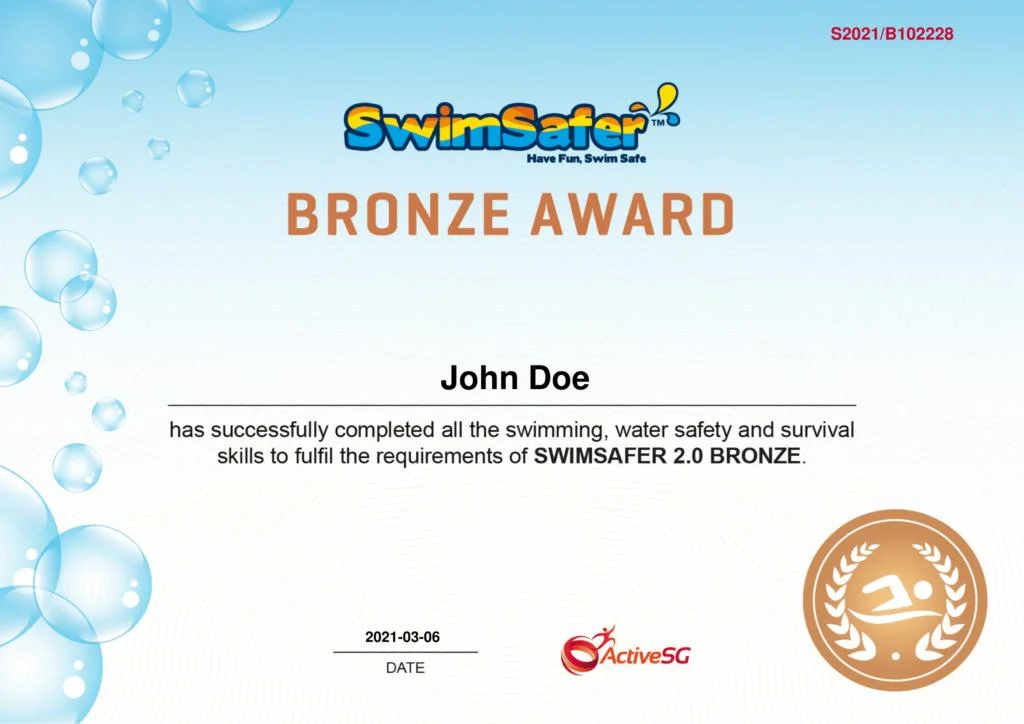
SwimSafer is Singapore's mandatory national water safety program, developed by SportSG to teach water safety and swimming skills through six progressive stages.
Introduction to Water Skills
Clothing Requirement
More complex survival techniques are introduced in Stage 4, and attire is a key factor in making things more challenging. Participants must show that they can tread water and conduct throw rescues while still wearing swimwear, shorts, and a t-shirt.
This stage teaches students how to stay buoyant and save energy despite the drag on their clothing, which is physically taxing when swimming in wet garments. The experience mimics real-life situations when being able to swim and perform rescues while clothed is crucial for survival, such getting caught in a flood or falling into deep water.
Test Criteria
Entries & Exits
- Compact jump.
Sculling & Body Orientation
- Forward somersault in the water.
- Scull, float or tread for 2 min
Underwater Skills
In at least 1.4m deep water, perform feet-first surface dive, swim through hoops on pool bottom or 2m.
Movement / Swimming / Strokes
- Swim 100m continuously:
- 25m Front Crawl.
- 25m Backstroke.
- 25m Breaststroke.
- 25m Survival Backstroke.
Survival & Activity Skills
- Scull, float or tread water for 2 min.
- Dressed in swimwear, shorts and t-shirt demonstrate:
- 3 min swimming slowly using survival backstroke, sidestroke and survival breaststroke, changing every 15m.
- Wave and call for help Retrieve a flotation aid thrown by a 'rescuer' (2m away) and kick to the side of the pool and exit.
Rescue Skills
Throw a flotation aid to a partner 2m away and instruct the partner to kick to the edge.
Knowledge
- Principles of Personal Safety and Survival.
- Environmental Awareness.
- Health Awareness.
- Emergency Situations and Survival Techniques.
- Rescues.