

The honest answer: there is no universal lesson count
A responsible swim school cannot tell every beginner in Singapore that the same number of private lessons will be enough. A child who enters calmly but needs breathing help is not starting from the same place as a child who will not leave the pool steps. An adult refining a basic stroke is not starting from the same place as an adult who cannot yet float or exhale in the water.
The useful answer is a planning process: establish what the learner can do today, define one meaningful goal, choose an observable checkpoint, and set a review point. Only then can the coach explain whether the current pace, format, pool, and goal still make sense.
Define what "learning to swim" means for this learner
Families often use the same phrase for very different outcomes. One learner may want to enter the water without fear. Another may want to float, recover to standing, breathe with control, swim a recognisable stroke, prepare for a SwimSafer stage, or become more comfortable at a condo pool. These are different goals and should not share an assumed timeline.
Write the goal in plain language before asking about lesson count. "My child should hold the wall and return to it calmly" gives the coach something observable. "Learn swimming quickly" does not explain the starting point, the skill, or what success should look like.
Start with a baseline the learner can demonstrate
Describe what happens in the water now, not what a previous certificate, holiday lesson, or family memory suggests. Can the learner enter willingly, place the face in the water, exhale, float with or without support, regain standing, hold the wall, follow a cue, and move with control? Also share fear triggers, previous lessons, time away from swimming, and any support needs relevant to the lesson.
This is not a medical or clinical assessment. It is a practical lesson baseline. A coach should update the teaching plan when the observed starting point differs from the enquiry, without treating hesitation as failure or promising that one format will solve every difficulty.
Use observable checkpoints instead of a package promise
A checkpoint should be visible to the learner, parent, and coach. For a nervous beginner it could be a calmer entry, controlled bubbles, supported floating, or returning to the wall on cue. For a learner with foundations, it could be repeating one breathing or body-position correction with less prompting.
Agree what the coach will review and when the family will receive an honest update. The review should ask whether the skill is becoming more consistent, whether fear or fatigue is changing, and whether the present goal remains appropriate. It should not turn an early observation into a guaranteed completion date.
Private lessons can improve fit, not guarantee speed
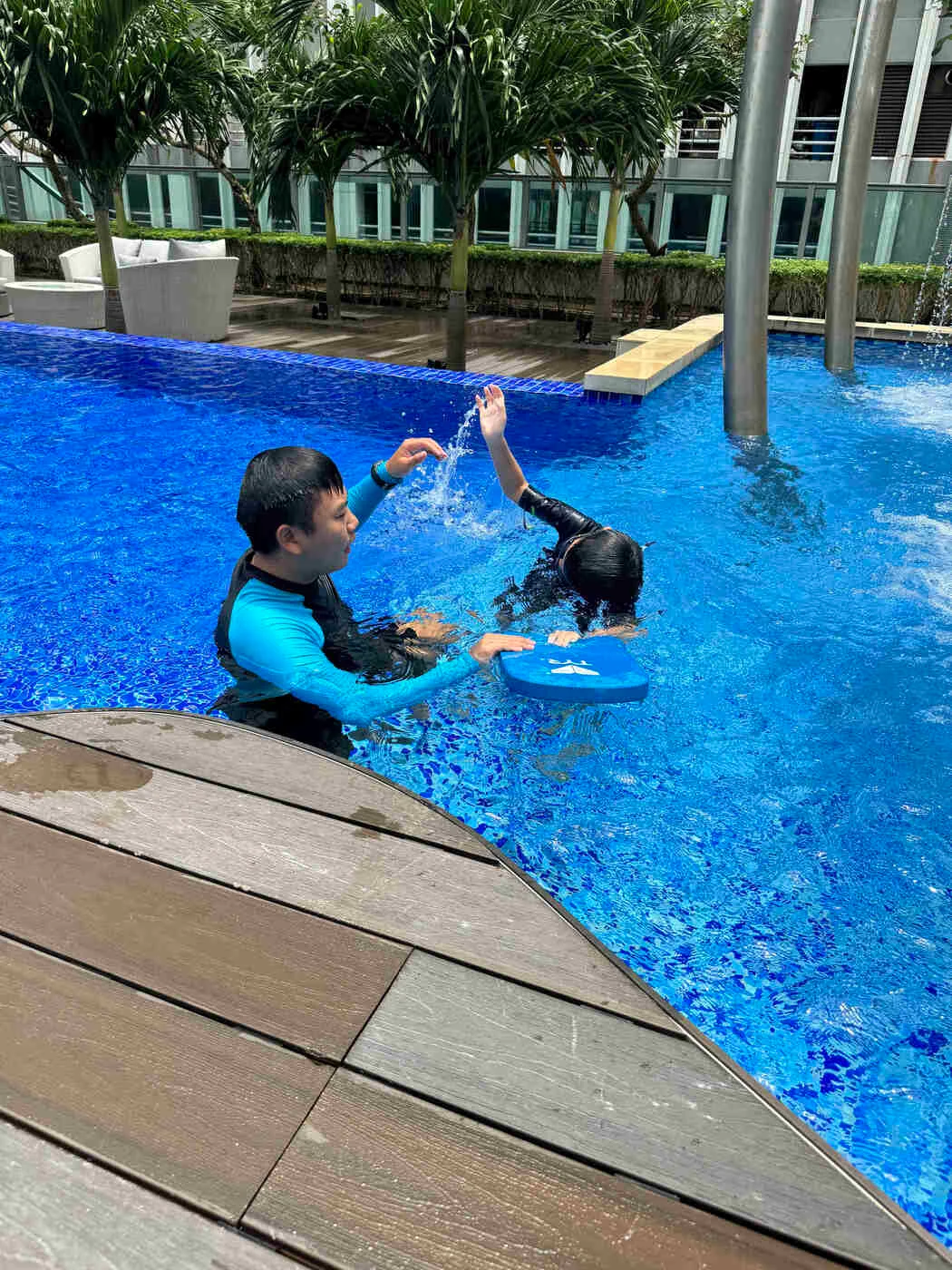
One-to-one lessons can suit a beginner who needs close feedback, privacy, fewer distractions, a slower pace, or teaching at a suitable condo or private pool. They can also make it easier for the coach to narrow the lesson around one current blocker instead of dividing attention across a group.
That closer attention is a format advantage, not proof of a faster result. A well-matched group may suit a learner who is comfortable around peers and can progress while attention is shared. The decision should follow the learner's behaviour, goal, and practical setup rather than an assumption that private coaching is always better.
Pool access and coach fit change the plan
In Singapore, the intended pool is part of the lesson plan. For a condo or private pool, confirm whether outside coaching is allowed, how visitor access works, and whether there is a suitable teaching area. Share the pool depth, busy periods, access instructions, and management rules before expecting an arrangement to be confirmed.
Coach fit matters as well. A nervous child may respond to a different tone or pace. An adult may need clearer explanation, more privacy, or a coach comfortable teaching true beginners. If communication is poor or the learner becomes less settled, review the match instead of buying more lessons on the assumption that volume will fix it.
Continuity and practice need honest boundaries
Regular attendance can help a coach build on the last lesson, but attendance alone does not establish progress. Sleep, illness, fear, school or work demands, pool conditions, and long gaps can change what the learner can manage on a given day. A realistic plan should allow the goal and pace to be adjusted.
Any practice outside a coached lesson should match the learner's demonstrated ability and the pool's rules. This article does not certify a learner for independent or deep-water swimming and does not replace active adult supervision, venue requirements, or a coach's in-person judgement.
Keep SwimSafer and stroke goals in their proper place
Sport Singapore describes SwimSafer as a progressive national water-safety programme. That supports staged skill and goal planning; it does not provide a standard number of private lessons or prove when an individual learner will be ready for a stage, distance, deep water, independent swimming, or a safety outcome.
ActiveSG publishes swimming learning resources for foundations and technique. Use them to understand that swimming contains separate skills, not to calculate a private-lesson package. The coach still needs to observe the learner and explain which foundation comes next.
Questions to ask at each review point
Ask what the learner can now do with less help, what remains inconsistent, what fear or fatigue is showing, and whether the pool or coach setup is helping. Ask what the next observable checkpoint is and what would cause the plan to slow down, change format, or pause.
Also ask what is not being promised. A clear answer should separate an instructional goal from a guarantee about lesson count, stroke, distance, safety, SwimSafer, coach, pool, slot, price, or completion date.
What to send Penguin for a useful recommendation
Send the learner's age, present water confidence, what they can demonstrate now, previous lesson history, one explicit goal, preferred area or exact pool, pool-access rules, available days and times, privacy or communication needs, and whether the enquiry is for a child or adult.
Penguin can then check whether a private, adult, kids, condo, or SwimSafer-support route appears suitable. This guide does not promise a fixed lesson count, package, coach, pool, slot, price, progress rate, or outcome. Any arrangement remains subject to learner fit, pool access and rules, schedule, capacity, and coach availability.