

Why parents are asking more safety questions
Recent local reporting has reminded many Singapore parents that choosing a swimming coach is not only about location, price, or available timing.
Parents are right to ask stronger questions. A swimming lesson involves physical guidance, water risk, child trust, and coach judgement. The school should be able to explain how safety and conduct are handled.
What professional physical guidance should look like
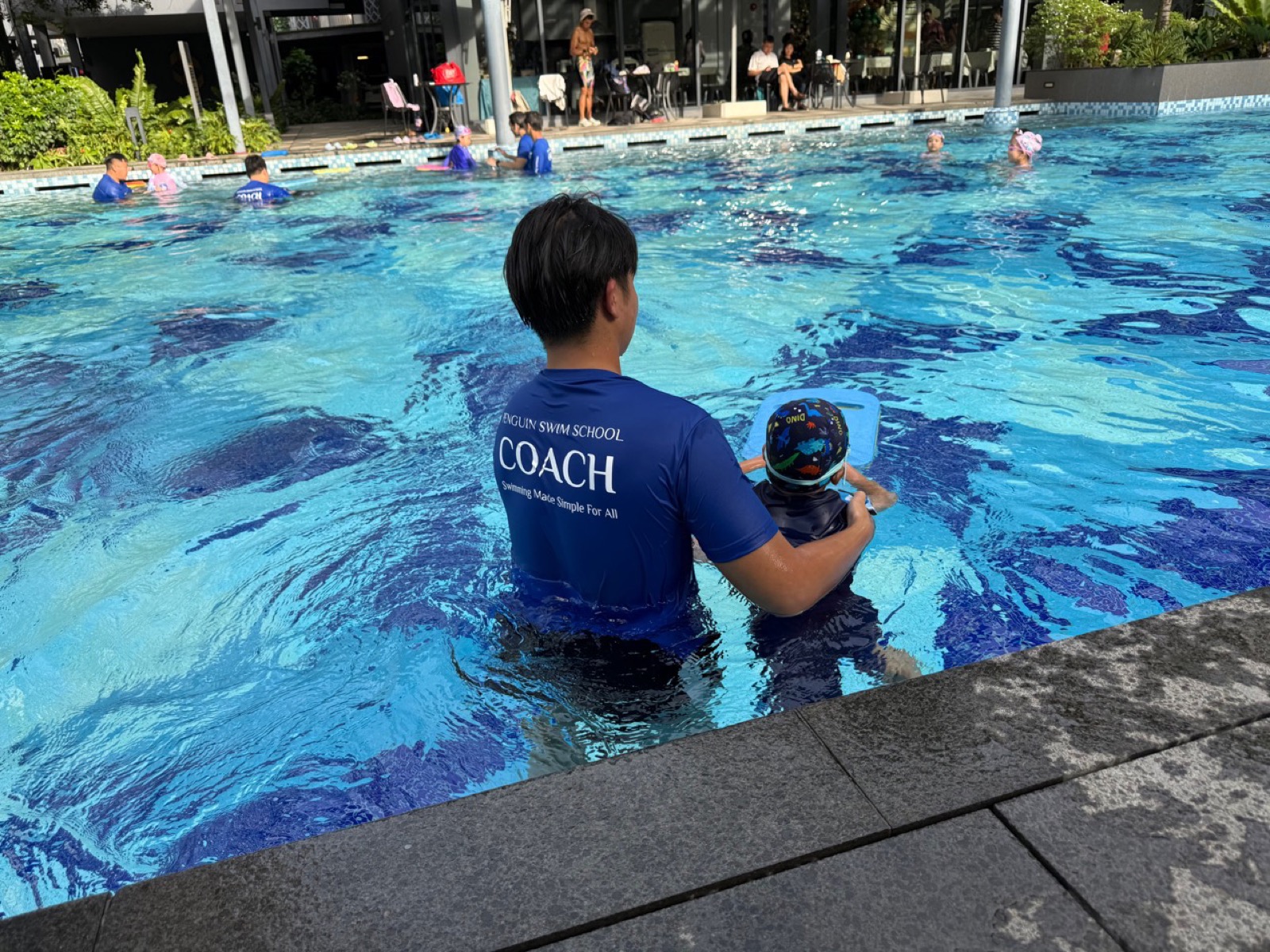
Swimming instruction can require a coach to demonstrate movement, support floating, guide a kick, or respond to an immediate safety risk. That contact should be necessary, appropriately bounded, explainable, and respectful of the learner’s comfort.
SportSG’s Safe Sport guidance says coaches should work in an open environment and follow the Rule of Two. Parents should be able to observe the general lesson environment and understand the purpose of major drills rather than being asked to accept unclear or hidden handling.
What parents should check before booking
Ask for the assigned coach’s name, relevant credentials, how physical guidance is explained and limited, whether the lesson can be observed, how coach-to-child communication is handled, and which management contact receives a safeguarding concern.
A qualification is useful evidence of baseline competence, but it is not a complete safeguarding system by itself. Coach selection, clear boundaries, observation, professional communication, and an escalation path all matter.
What to watch and ask during lessons
Look for purposeful drills, clear instructions, and a lesson environment that remains generally visible. Notice patterns rather than guessing motives: unexplained contact, attempts to isolate a learner, secretive communication, or repeated learner discomfort should be questioned.
After class, use neutral questions such as “How did the lesson feel?” and “Was there anything you did not like?” Do not suggest an answer. The aim is to make it easy for the learner to speak honestly.
If a learner raises a concern
Make the learner safe and stop further contact with the person of concern while advice is obtained. Stay calm, listen at the learner’s pace, take the concern seriously, and record the learner’s own words and relevant timing. Do not blame the learner, promise secrecy that prevents protection, or conduct an amateur investigation.
For immediate danger, call Police at 999. SMS 70999 is available when it is unsafe to call or the person cannot speak. Abuse concerns may also be reported to the 24-hour National Anti-Violence and Sexual Harassment Helpline at 1800-777-0000, while sport-related concerns can be raised through Safe Sport.
Penguin’s standard
Penguin Swim School treats coach conduct and learner safety as non-negotiable. Inappropriate behaviour has no place in our lessons.
We expect coaching contact to be necessary for instruction or immediate safety, professionally bounded, explained where practical, and observable. Families should raise any concern with Penguin management promptly so the learner can be protected and the matter can be documented and escalated to the appropriate authority.
Penguin management has stated that no comparable occurrence has been reported to management since incorporation. That is a management-reported position, not a guarantee that any organisation is immune from risk. Our continuing standard is vigilance, appropriate boundaries, professional communication, and a culture in which learners and families can speak up.
What to tell Penguin when enquiring
Share the learner age, water confidence, preferred pool, parent concerns, and whether the learner needs a male or female coach, private lesson, or smaller class format.
The more clearly we understand the learner and family concern, the better we can recommend a coach and setup that fits properly.